

A single operator loading and unloading parts by hand limits your tapping center to 60–70% spindle utilization. The machine waits while the operator reaches for the next blank. A CNC automatic loading system eliminates that wait. It feeds parts continuously, keeps the spindle cutting, and pushes utilization above 90%. This article explains how to add automatic loading and unloading to an existing or new drilling/tapping center—and what it takes to achieve full automated production.
Why Manual Loading Limits Your Throughput
Manual handling creates three bottlenecks. First, cycle time extends by 8–15 seconds per part for load/unload. Second, the operator’s fatigue increases reject rates after hour four of a shift. Third, you cannot run lights-out. The machine sits idle overnight.
Consider a typical M6 tapping operation on 2 mm SUS304 brackets. Cutting time is 4.2 seconds per hole, six holes per part. Total machining time: 25.2 seconds. Manual load/unload adds 12 seconds. That 12 seconds represents 32% of the total cycle. Eliminate it, and you gain 32% more parts per shift.
The Real Cost of Waiting
A tapping center running 16 hours per day at €45/hour machine cost loses €7,200 per month to manual load/unload delays—assuming 30% idle time. Over three years, that exceeds €250,000. A gantry loader costs €18,000–€35,000. Payback: 3–6 months.
For buyers evaluating CNC drilling and tapping machines, automation readiness should rank alongside spindle speed and axis travel. A machine that cannot accept a loader locks you into manual operation forever.
Types of CNC Automatic Loading Systems
Four main configurations dominate the market. Each suits different part geometries, batch sizes, and floor space constraints.
Gantry Loaders
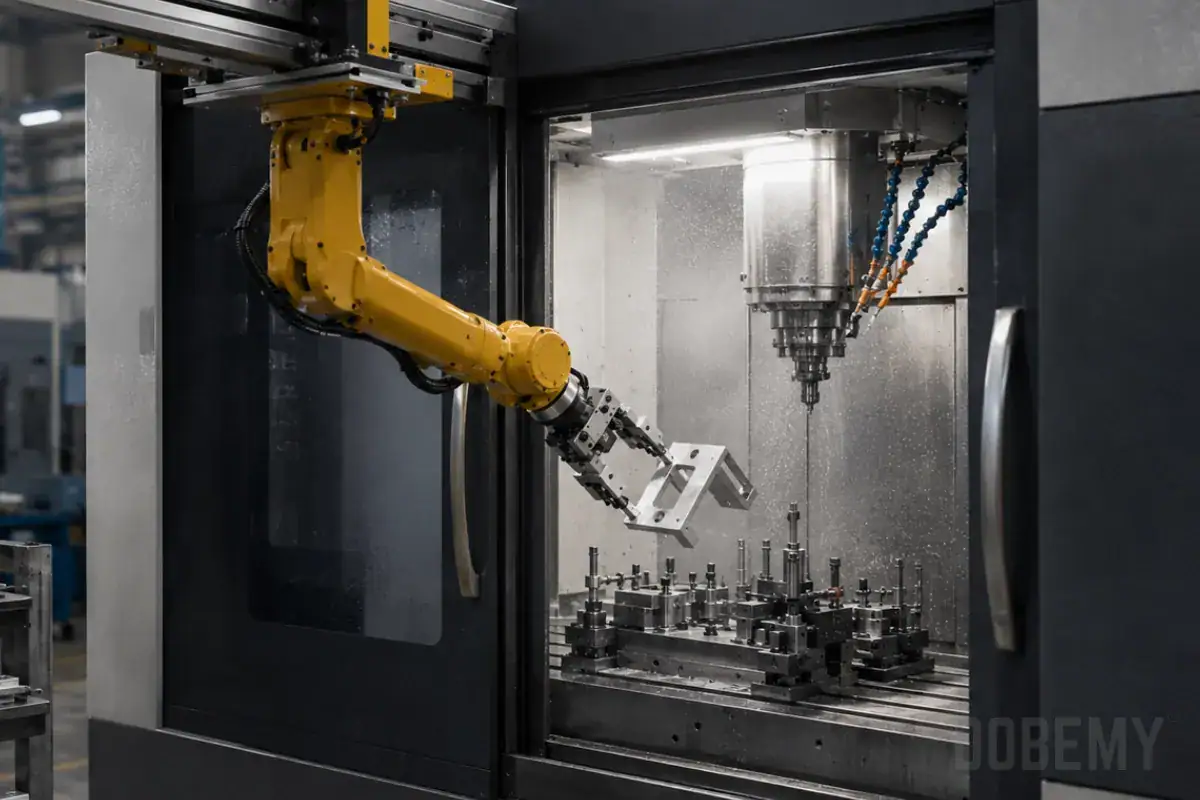
A gantry loader mounts above the machine. It picks parts from a tray or conveyor, moves along X-Y-Z axes, and places them on the fixture. Gantry loaders handle parts up to 15 kg. They excel at high-volume, single-part-type production.
- Repeatability: ±0.05 mm typical
- Cycle overhead: 3–5 seconds
- Footprint: minimal—uses vertical space
- Cost: €18,000–€35,000
Articulated Robot Arms
A 6-axis robot (Fanuc, KUKA, ABB, or Chinese brands like ESTUN) offers flexibility. It can load multiple machine types, handle complex part orientations, and perform secondary tasks like deburring or inspection. Payload ranges from 3 kg to 25 kg for typical tapping center applications.
- Repeatability: ±0.02–±0.05 mm
- Cycle overhead: 4–8 seconds
- Footprint: requires floor space beside the machine
- Cost: €25,000–€60,000 (robot + gripper + integration)
Rotary Pallet Systems
A rotary pallet changer swaps fixtures rather than individual parts. While one pallet is machined, the operator loads the next. This approach suits larger workpieces or multi-part fixtures. It reduces—but does not eliminate—operator involvement.
Bowl Feeders and Vibratory Systems
For small parts (under 50 mm, under 200 g), bowl feeders orient and singulate parts automatically. They feed into a pick station where a loader or robot grabs them. Bowl feeders handle 20–60 parts per minute depending on geometry.
Choosing the right system depends on your part mix. For guidance on matching equipment to workpiece characteristics, see our material selection guide.
Integration Requirements: What Your Machine Needs
Not every tapping center accepts automation. Before purchasing a loader, verify these requirements.
Control System Compatibility
The machine controller must support M-code handshaking with the loader. Standard signals include:
- M-code for “cycle complete, ready for unload”
- M-code for “part loaded, ready to clamp”
- Door interlock signals (safety)
- Fault/alarm relay outputs
Fanuc 0i-MF, Mitsubishi M80, and Siemens 828D all support these signals natively. Older controllers may require a PLC retrofit. The Fanuc vs. Siemens comparison covers control system capabilities in detail.
Automatic Door Mechanism
Manual sliding doors block automation. You need a pneumatic or servo-driven auto-door with position feedback. Retrofit cost: €1,500–€4,000. Many Chinese tapping centers now offer auto-door as a factory option—specify it at order time.
Fixture Design
The fixture must clamp and release automatically. Hydraulic or pneumatic clamping with position sensors is standard. Manual toggle clamps do not work. Fixture redesign adds €2,000–€8,000 depending on complexity.

Safety Enclosure
CE and ISO 13849 require risk assessment when integrating robots. You need light curtains, safety mats, or a physical enclosure around the robot work envelope. Budget €3,000–€10,000 for safety hardware and certification documentation. European buyers should reference our CE marking guide for compliance details.
Comparison: Gantry Loader vs. Robot Arm
The table below compares the two most common automation approaches for tapping and drilling centers.
| Criterion | Gantry Loader | 6-Axis Robot Arm |
|---|---|---|
| Initial cost | €18,000–€35,000 | €25,000–€60,000 |
| Repeatability | ±0.05 mm | ±0.02–±0.05 mm |
| Cycle overhead | 3–5 seconds | 4–8 seconds |
| Flexibility (part variety) | Low—single part type | High—multiple part types |
| Floor space | Minimal (overhead mount) | 1.5–2.5 m² beside machine |
| Programming complexity | Low—teach points only | Medium—path planning required |
| Secondary tasks | None | Deburring, inspection, bin sorting |
| Best for | High-volume, single-part runs | Mixed production, multi-machine cells |
For high-volume production of a single part family, gantry loaders deliver faster payback. For job shops with frequent changeovers, robot arms justify the higher cost through flexibility.
Step-by-Step: Adding Automation to an Existing Machine
Follow this checklist to retrofit a CNC automatic loading system to your current tapping or drilling center.
- Audit the controller. Confirm M-code handshaking capability. Request the I/O map from the machine builder.
- Measure the work envelope. Document fixture height, door opening width, and clearance above the table.
- Select the loader type. Match payload, reach, and cycle time to your part requirements.
- Design or modify the fixture. Add hydraulic/pneumatic clamping with position feedback.
- Install the auto-door. Retrofit pneumatic cylinders and limit switches if not already present.
- Integrate safety systems. Install light curtains or enclosure. Perform risk assessment per ISO 13849.
- Commission and test. Run 500+ cycles to verify repeatability and fault handling.
- Train operators. Cover startup, shutdown, fault recovery, and gripper changeover.
Total retrofit timeline: 4–8 weeks from order to production. Buyers importing equipment from China can request factory pre-integration—the loader ships mounted and tested. This reduces on-site commissioning to 2–3 days. Our import process checklist covers logistics and customs for integrated systems.
Achieving Full Automated Production: Beyond the Loader
A loader alone does not create full automation. You need four additional elements.
Part Storage and Buffering
The loader needs a supply of blanks and a destination for finished parts. Options include:
- Tray stackers: 10–50 trays, each holding 20–100 parts
- Conveyor infeed/outfeed: continuous flow, suits high-volume lines
- Pallet magazines: for larger parts or multi-part fixtures
A 50-tray stacker holding 30 parts per tray provides 1,500 parts of buffer. At 45-second cycle time, that supports 18+ hours of unattended operation.
In-Process Inspection
Lights-out production requires automatic quality verification. Options include:
- Touch probes: verify part presence and position before machining
- Vision systems: check hole count, thread presence, surface defects
- Thread gauges: go/no-go verification integrated into the unload station
Reject parts route to a separate bin. The system logs the failure and continues production.
Tool Life Management
Unattended operation demands automatic tool monitoring. The controller tracks tool life by cut count or cutting time. When a tap approaches its limit (e.g., 8,000 holes for an M6 tap in SUS304), the system either:
- Switches to a redundant tool in the magazine
- Pauses and alerts the operator via SMS or email
Redundant tooling adds cost but enables true lights-out capability. For spindle and tooling considerations, see our spindle speed selection guide.
Chip and Coolant Management
Chips accumulate. Coolant levels drop. For 8+ hour unattended runs, you need:
- Chip conveyor with sufficient capacity
- Coolant tank with level sensor and auto-refill
- Mist collector to maintain air quality
ROI Calculation: When Does Automation Pay Off?
Use this framework to calculate payback for your specific situation.
Variables
- Current cycle time (manual): machining time + load/unload time
- Automated cycle time: machining time + loader overhead (3–8 seconds)
- Shifts per day: 1, 2, or 3
- Machine hourly rate: fully loaded cost including labor, overhead, depreciation
- Automation system cost: loader + fixture + safety + integration
Example Calculation
Current state: 37-second cycle (25s machining + 12s manual handling), 2 shifts (16 hours), €45/hour machine rate.
Parts per day: (16 × 3600) / 37 = 1,557 parts
Automated state: 30-second cycle (25s machining + 5s loader), 3 shifts (24 hours, lights-out third shift).
Parts per day: (24 × 3600) / 30 = 2,880 parts
Increase: 1,323 additional parts per day (85% improvement).
If margin per part is €0.80, daily gain is €1,058. Monthly gain: €22,000+. Automation cost of €40,000 pays back in under 2 months.
Even conservative scenarios (single shift, modest cycle time reduction) typically show payback under 12 months. For detailed ROI analysis methods, see our axis configuration ROI guide.
Specifying Automation When Ordering from China
Chinese tapping center manufacturers increasingly offer integrated automation packages. When requesting quotes, specify:
- Part dimensions, weight, and material
- Target cycle time (machining only)
- Desired buffer capacity (hours of unattended operation)
- Safety standards required (CE, OSHA, local codes)
- Control system preference (Fanuc, Mitsubishi, Siemens)
Request a video of the integrated system running your part geometry (or a similar part) before finalizing the order. Confirm that the loader and machine ship as a tested unit—not separate components requiring on-site integration.
For supplier evaluation criteria, our guide to finding reliable Chinese CNC suppliers covers due diligence steps.
Key Takeaway
A CNC automatic loading system eliminates 8–15 seconds of manual handling per part, pushing spindle utilization from 60–70% to over 90%. Gantry loaders suit high-volume single-part production (€18,000–€35,000). Robot arms suit mixed production and multi-machine cells (€25,000–€60,000). Full automated production requires part buffering, in-process inspection, tool life management, and chip/coolant handling. Payback typically occurs within 3–12 months. Specify automation requirements at order time to receive a factory-integrated, tested system.
Next Steps: Get a Customized Automation Quote
Every production scenario differs. Part geometry, batch size, floor space, and budget all influence the optimal automation configuration. At dobemy.com, we help overseas buyers specify and source tapping and drilling centers with integrated automatic loading systems—factory-tested and ready for production.
Contact our team with your part drawings, target cycle times, and production volume. We will recommend the right loader type, provide budgetary pricing, and connect you with manufacturers who deliver automation-ready equipment to Europe, North America, the Middle East, and beyond.
Request a customized quote and move from manual handling to full automated production.