

When your production line grinds to a halt because your CNC drilling center can’t handle the new titanium aerospace components your customer ordered, the cost isn’t just downtime—it’s lost contracts and damaged reputation. Smart buyers know that CNC drilling center material selection is the foundation of efficient manufacturing, yet many procurement managers still choose equipment based on price alone, only to discover their machines struggle with harder alloys or precision requirements for specific materials.
Material compatibility drives everything from spindle torque requirements to coolant systems, tool magazine capacity, and even the machine’s structural rigidity. A drilling center optimized for aluminum will fail spectacularly when tasked with Inconel 718, while a machine built for heavy steel work might be overkill—and overpriced—for electronics manufacturing.
This guide breaks down the technical specifications, trade-offs, and real-world considerations that determine which CNC drilling center models excel with different workpiece materials. We’ll examine spindle requirements, structural design factors, and automation features that matter most for your specific material applications.
Understanding Material Properties That Drive CNC Drilling Center Material Selection
Different materials create distinct challenges for drilling and tapping operations. Aluminum alloys like 6061-T6 are forgiving—they machine quickly with standard HSS tools and generate manageable chip loads. However, stainless steel grades like 316L work-harden rapidly, requiring consistent feed rates and sharp carbide tools to prevent dulling.
Titanium alloys (Ti-6Al-4V) present the opposite challenge. These materials have low thermal conductivity, causing heat buildup that can damage both tools and workpieces. Similarly, Inconel and other superalloys demand high torque at low speeds, plus flood coolant to manage temperatures.
Composite materials like carbon fiber reinforced plastics (CFRP) require entirely different approaches. These materials are abrasive, dulling tools quickly, but they’re also prone to delamination if feed rates or spindle speeds aren’t properly controlled.
Critical Material Characteristics
Three key properties determine your machine requirements:
- Hardness (HRC rating): Materials above 35 HRC typically require carbide tooling and higher spindle torque
- Thermal conductivity: Low-conductivity materials like titanium need enhanced coolant systems
- Chip formation behavior: Long, stringy chips (common with aluminum) require different chip evacuation than brittle chips from cast iron
Spindle Specifications for Different Material Categories
Spindle selection represents the most critical decision in CNC drilling center material selection. The wrong spindle turns every operation into a struggle against physics.
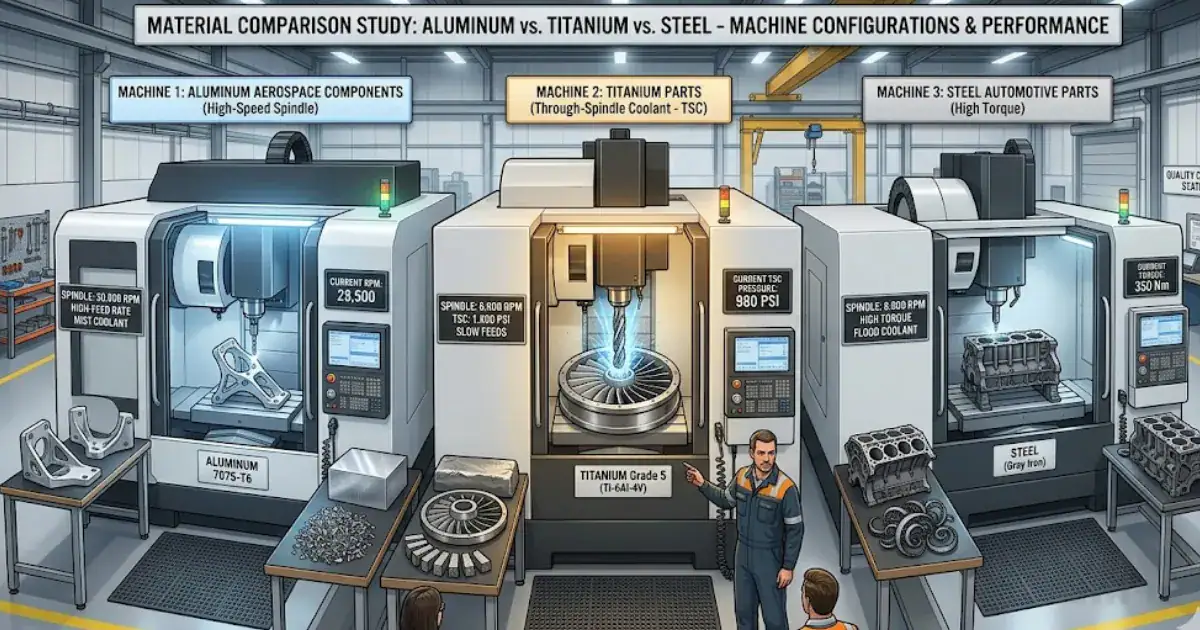
- Aluminum and softer materials (typically up to ~25 HRC): High-speed spindles excel here, offering strong productivity through 12,000–24,000+ RPM with moderate torque (often 15–30 Nm). The priority is achieving optimal surface speeds for high material removal rates and excellent finishes, rather than maximum cutting force.
- Steel alloys and stainless steels: These require a balanced spindle, commonly rated 6,000–12,000 RPM with 35–60 Nm (or higher) torque. Consistent torque delivery across the working speed range is essential—lower-quality spindles often suffer significant torque drop at higher RPMs, leading to poor performance under load.
- Superalloys and titanium: These difficult-to-machine materials demand high torque at lower speeds. Spindles capable of maintaining substantial torque (frequently 60 Nm or significantly more) at low RPMs (down to several hundred RPM) are preferred to handle high cutting forces without stalling. Many modern suppliers, including Chinese manufacturers, offer dual-range or geared spindles that combine high-speed capability with strong low-end torque, although this comes with added mechanical complexity and cost.
Spindle Bearing and Cooling Considerations
Material selection affects spindle bearing requirements too. Interrupted cuts in hard materials create shock loads that destroy ball bearings quickly. Tapered roller bearings or ceramic hybrid bearings extend life significantly, but increase machine cost by $8,000-$15,000.
Coolant integration matters especially for heat-sensitive materials. Through-spindle coolant (TSC) is essential for deep drilling in titanium or Inconel. Chinese manufacturers typically offer TSC as a $3,000-$5,000 option, while European machines include it standard on aerospace-grade models.
Structural Design Requirements Based on Material Hardness
Machine structure becomes critical when processing harder materials. Aluminum work can succeed on lighter machine frames, but steel and superalloys require substantial mass and rigidity to maintain accuracy under cutting forces.
Most Chinese tapping centers use cast iron bases, but the quality varies dramatically. Premium suppliers like Doosan Puma cast their beds in one piece with 6-month natural aging, while budget manufacturers use welded steel frames that lack vibration damping.
The key specification is dynamic stiffness, measured in N/μm. Machines processing aluminum typically need 100-200 N/μm stiffness, while titanium applications require 300+ N/μm. Unfortunately, many Chinese suppliers don’t publish dynamic stiffness data, focusing instead on static measurements that don’t reflect real machining performance.
Guideway Selection for Material Applications
Linear guideway choice significantly impacts material compatibility. Hardened steel ways excel with steady cutting forces but struggle with vibration from interrupted cuts. Rolling element linear guides handle shock loads better but have lower damping characteristics.
For aluminum and plastic applications, linear guides provide adequate stiffness with better acceleration. Steel and harder materials benefit from traditional box ways or hybrid designs that combine both technologies.
Chinese manufacturers increasingly offer hybrid guideway systems. The X and Y axes use linear guides for rapid positioning, while the Z-axis employs hardened ways for cutting rigidity. This approach balances cost, performance, and material versatility.
Tool Management Systems and Material-Specific Requirements
Tool magazine capacity and change speed requirements vary dramatically based on workpiece materials. Simple aluminum jobs might use 3-4 different tools, while complex titanium aerospace components require 20+ specialized cutting tools.
Materials that work-harden quickly, like certain stainless steels, need frequent tool changes to maintain surface quality. This drives requirements for fast tool changers (under 3 seconds) and large magazine capacity (40+ tools).
Chinese suppliers typically offer 24-tool magazines standard, with 40-tool options available for $8,000-$12,000 additional cost. European machines commonly include 40+ tools standard, but their base prices reflect this inclusion.
Tool Measurement and Breakage Detection
Material hardness directly affects tool life predictability. Aluminum operations might run thousands of holes before tool replacement, while titanium drilling may require changes every 100-200 operations.
Touch probes for tool measurement become essential for unpredictable tool wear patterns. Laser tool measurement systems ($15,000-$25,000) provide faster, more accurate monitoring than contact probes but add significant cost.
Tool breakage detection protects expensive workpieces, especially critical for aerospace titanium components where scrapped parts cost thousands of dollars. Adaptive control systems monitor cutting forces and stop operations automatically when tools fail.
Coolant and Chip Management for Material-Specific Applications
Coolant system design varies significantly based on material thermal properties and chip formation characteristics. The wrong coolant approach can destroy part quality, reduce tool life, and create maintenance nightmares.
Aluminum generates long, stringy chips that clog standard flood coolant systems. High-pressure coolant (20-30 bar) breaks chips effectively and provides excellent heat removal. However, aluminum’s excellent thermal conductivity means heat isn’t the primary concern—chip evacuation is.
Titanium presents the opposite challenge. Poor thermal conductivity causes rapid heat buildup, but titanium chips are generally shorter and easier to evacuate. Through-spindle coolant becomes essential, delivering coolant directly to the cutting zone where heat generation occurs.
Stainless steel combines both challenges. Work hardening generates significant heat, while some grades produce difficult chips that wrap around tools. These materials often require both high-pressure external coolant and through-spindle delivery.
Coolant System Specifications by Material
| Material Category | Coolant Pressure (bar) | Flow Rate (L/min) | Through-Spindle Required | Filter Requirements |
|---|---|---|---|---|
| Aluminum Alloys | 20-30 | 60-80 | Optional | 50 micron |
| Steel/Stainless | 15-25 | 40-60 | Recommended | 25 micron |
| Titanium/Superalloys | 40-80 | 20-40 | Essential | 10 micron |
| Composites | 10-15 | 30-50 | No | 100 micron |
Chinese manufacturers often underspec coolant systems to hit price targets. A typical Chinese drilling center includes a 40L/min pump, adequate for aluminum but insufficient for demanding titanium applications. Upgrading to high-pressure systems adds $5,000-$8,000 but prevents costly production delays.
Chip Evacuation and Filtration
Chip handling requirements vary dramatically by material. Aluminum chips are voluminous but lightweight, requiring large chip conveyors but simple filtration. Cast iron produces fine particles that contaminate coolant quickly, demanding centrifugal separators or magnetic filtration.
Titanium and superalloys create fire hazards. Dry titanium chips ignite easily, making chip evacuation and coolant coverage critical safety requirements. Many insurance companies now require specific fire suppression systems for titanium machining operations.
Composite materials generate abrasive dust rather than chips. Standard chip conveyors fail quickly, while dust collection systems become essential for both equipment protection and worker safety.
Automation and Integration Considerations
Material characteristics drive automation requirements differently. High-volume aluminum production benefits from simple pallet changers that maximize utilization of the machine’s rapid cutting capability.
Titanium and aerospace materials require more sophisticated automation. Long cycle times (often 2-4 hours per part) make pallet systems essential, but the focus shifts from throughput to unmanned reliability and quality consistency.
Composite materials often require special fixturing to prevent delamination. Standard pneumatic clamping may be insufficient, requiring vacuum clamping systems or custom fixture plates that integrate with automation equipment.
Quality Control Integration
Different materials drive different quality control requirements. Aluminum aerospace components might require 100% dimensional inspection, while steel production parts need only statistical process control.
In-process measurement becomes critical for materials with unpredictable behavior. Titanium’s work-hardening characteristics can cause dimensional drift during long machining cycles, requiring adaptive control systems that adjust parameters automatically.
Many Chinese suppliers now offer integrated measurement systems, though quality varies. Key technical parameters for measurement systems should include probe accuracy (typically ±2 microns), measurement speed, and integration with machine control systems.

Cost Analysis and ROI Considerations by Material Type
Initial machine cost represents only 30-40% of total ownership cost over a 10-year period. Material-specific requirements dramatically affect operating costs, tool consumption, and maintenance expenses.
Aluminum operations typically achieve the lowest per-part costs due to fast cutting speeds and long tool life. A properly configured machine might achieve $0.50-$2.00 per drilled hole, depending on complexity and volume.
Steel and stainless steel increase per-part costs to $2.00-$5.00 per hole due to slower speeds and more frequent tool changes. However, these materials often command higher part prices, maintaining profitability.
Titanium and superalloy operations can reach $10-$50 per drilled hole due to extremely slow cutting speeds, expensive tooling, and frequent tool changes. These costs are only justified by high-value aerospace and medical applications.
Hidden Costs by Material Category
Energy consumption varies significantly by material. Aluminum operations use 3-5 kWh per hour of machining time, while titanium applications can consume 15-20 kWh due to high coolant pump power and longer cycle times.
Maintenance costs scale with material difficulty. Aluminum operations might require major maintenance every 8,000-10,000 hours, while superalloy applications need attention every 3,000-4,000 hours due to higher stresses on machine components.
Tool costs represent 15-25% of operating costs for aluminum, but can reach 40-50% for titanium operations. This dramatically affects equipment payback calculations and should influence machine selection decisions.
Quality Standards and Certification Requirements
Different industries impose varying quality standards that affect machine selection. Aerospace titanium work requires AS9100 certification, which mandates specific quality control capabilities and documentation systems.
Medical device manufacturing (ISO 13485) has different requirements focused on traceability and process validation. These standards often require integrated measurement systems and automated documentation that standard industrial machines lack.
Automotive applications (IATF 16949) emphasize statistical process control and mistake-proofing. Machine selection must consider built-in SPC capabilities and poka-yoke features that prevent quality escapes.
Chinese suppliers increasingly understand these requirements. However, certification compliance varies significantly between manufacturers. CE marking requirements for European buyers add another layer of complexity, as not all Chinese manufacturers maintain proper certification documentation.
Validation and Testing Requirements
Material-specific applications often require capability studies and process validation. Aerospace titanium work might demand Cpk values above 1.67, while automotive steel applications accept Cpk > 1.33.
Machine acceptance testing should reflect intended materials. Standard acceptance tests using aluminum samples don’t validate performance with titanium or superalloys. Smart buyers specify acceptance criteria based on their actual production materials.
Long-term capability studies become critical for demanding materials. A machine that passes initial acceptance might fail capability requirements after 500-1000 hours of titanium operation due to wear characteristics not apparent during short-term testing.
Key Takeaway
CNC drilling center material selection requires matching machine specifications to material characteristics, not just price comparison. Spindle torque, structural rigidity, coolant systems, and automation features must align with your specific material requirements. A $150,000 machine optimized for aluminum will fail catastrophically on titanium work, while a $400,000 aerospace-grade machine represents waste for simple steel applications. Focus on total cost of ownership over 7-10 years, including energy, tooling, and maintenance costs that vary dramatically by material type.
Making the Final Selection Decision
Successful CNC drilling center material selection requires a systematic approach that considers both current needs and future flexibility. Start by categorizing your workpiece materials into primary (80% of volume), secondary (15% of volume), and occasional (5% of volume) applications.
Optimize machine selection for primary materials while ensuring secondary materials remain feasible. Occasional materials might require subcontracting rather than compromising machine selection for rare applications.
Consider material trends in your industry. Automotive manufacturers increasingly use aluminum and advanced high-strength steels, while aerospace continues pushing toward more exotic alloys. Machine selection should anticipate these trends rather than just address current requirements.
Chinese suppliers offer significant cost advantages, but buyer diligence becomes critical. Finding reliable suppliers requires thorough evaluation of technical capabilities, quality systems, and post-sale support infrastructure.
Request material-specific demonstrations whenever possible. A machine that impresses you while cutting aluminum samples might struggle with your actual stainless steel production parts. Insist on demonstrations using your materials, tooling, and cycle times.
Finally, consider the total ownership experience. Validating machine performance and establishing clear acceptance criteria protects your investment while ensuring the selected machine delivers promised capabilities across your material range.
Ready to find the perfect CNC drilling center for your specific material applications? Our team at dobemy.com has helped hundreds of manufacturers navigate these complex decisions, matching machine capabilities to real-world production requirements. Contact us today for a personalized consultation that considers your materials, volumes, and quality requirements. We’ll connect you with pre-qualified Chinese suppliers who understand your industry’s demands and can provide the technical support necessary for long-term success.