

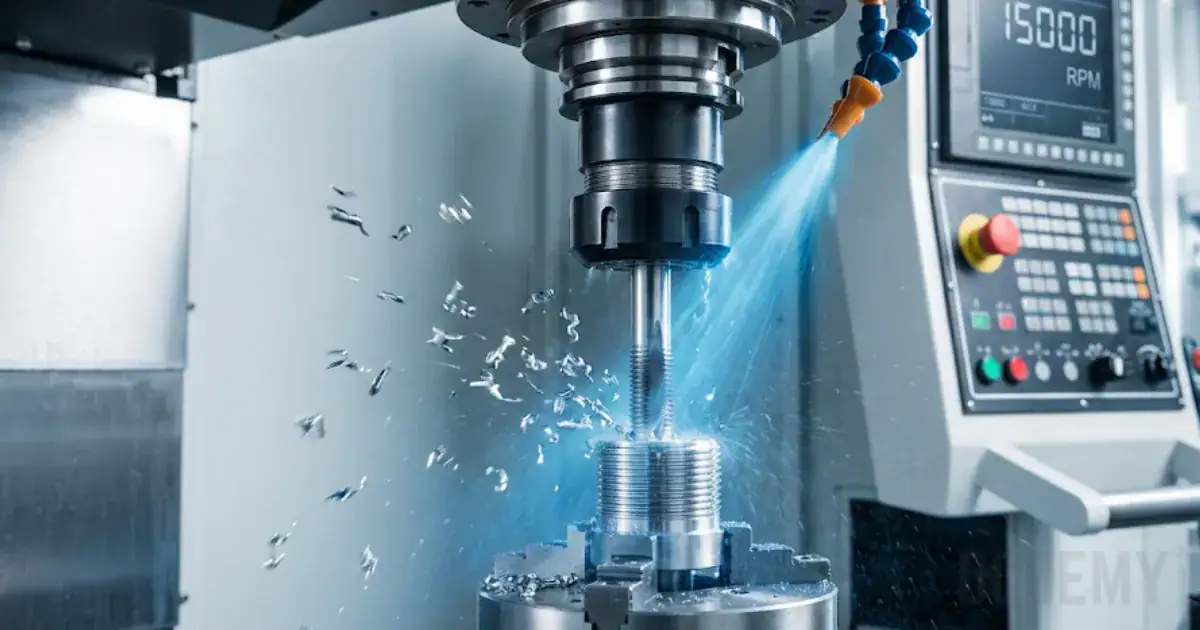
Your new CNC tapping center arrives. The spindle hits 24,000 RPM. But your aluminum parts come out with chatter marks. The problem? You matched the wrong spindle speed range to your workpiece material. CNC spindle speed selection determines whether your machine produces precision parts or expensive scrap. Get it wrong, and you lose money on every cycle.
Spindle speed affects surface finish, tool life, and cycle time. High-speed spindles excel at light cuts in aluminum. Low-speed, high-torque spindles power through steel. Most buyers need something in between. This guide shows you how to find that balance.
Understanding CNC Spindle Speed Selection Fundamentals
Spindle speed is measured in revolutions per minute (RPM). Torque is measured in Newton-meters (Nm). These two values have an inverse relationship. As RPM increases, available torque decreases. This is physics, not marketing.
A spindle rated at 24,000 RPM and 3.7 kW produces roughly 1.5 Nm at maximum speed. The same spindle at 6,000 RPM delivers approximately 5.9 Nm. This four-fold torque increase matters when cutting harder materials.
The Speed-Torque Curve Explained
Every spindle has a power curve. Below the “knee” speed, torque remains constant. Above it, torque drops as speed rises. Most tapping centers have knee speeds between 4,000 and 8,000 RPM.
For example, a Brother TC-S2DN spindle maintains constant torque up to 6,000 RPM. Above that, power stays constant but torque falls. Understanding this curve helps you match spindle capability to cutting requirements.
Why Material Dictates Speed Requirements
Different materials require different surface speeds. Surface speed (measured in meters per minute) determines cutting efficiency. The formula is simple: RPM = (Surface Speed × 1000) ÷ (π × Tool Diameter).
Aluminum cuts best at 200-500 m/min surface speed. Steel requires 80-150 m/min. Stainless steel needs 50-100 m/min. A 10mm end mill in aluminum needs 6,366-15,915 RPM. The same tool in stainless steel needs only 1,592-3,183 RPM. For detailed material-specific guidance, see our workpiece material selection guide.

Matching Spindle Speed Range to Your Production Needs
Your production mix determines your ideal spindle speed range. Single-material shops have simpler choices. Job shops processing multiple materials need versatile spindles.
High-Speed Spindles: 15,000-30,000 RPM
High-speed spindles suit these applications:
- Aluminum and aluminum alloys (6061, 7075, ADC12)
- Brass and copper alloys
- Plastics and composites
- Small-diameter tooling (under 6mm)
- High-volume production with light cuts
These spindles typically deliver 2-4 Nm torque at maximum speed. They excel at rapid material removal in soft metals. Cycle times drop by 30-50% compared to conventional speeds.
Mid-Range Spindles: 8,000-15,000 RPM
Mid-range spindles offer the best versatility. They handle:
- Mild steel and carbon steel
- Aluminum with larger tools
- Cast iron
- Mixed-material production
Torque ratings typically reach 8-15 Nm. This range covers 80% of general machining applications. Most Chinese tapping centers ship with spindles in this category. Check our technical parameters guide for detailed specifications.
High-Torque Spindles: 4,000-8,000 RPM
High-torque spindles power through difficult materials:
- Stainless steel (SUS304, SUS316)
- Tool steel and hardened steel
- Titanium alloys
- Large-diameter tapping operations
These spindles deliver 20-40 Nm torque. They sacrifice speed for cutting force. Cycle times increase, but tool life improves dramatically in hard materials.
CNC Spindle Speed Selection: Calculating Your Requirements
Proper selection requires calculation, not guesswork. Follow this process to determine your optimal speed range.
Step 1: Identify Your Primary Materials
List the materials you machine most frequently. Assign percentages to each. If 70% of your work involves aluminum and 30% involves steel, prioritize aluminum speeds.
Step 2: Determine Tool Diameters
Catalog your most-used tool sizes. Small tools need higher RPM to achieve proper surface speeds. A 3mm end mill in aluminum needs 21,220 RPM for 200 m/min surface speed. A 12mm tool needs only 5,305 RPM.
Step 3: Calculate Required RPM Range
Use this table to find your speed requirements:
| Material | Surface Speed (m/min) | 6mm Tool RPM | 10mm Tool RPM | 16mm Tool RPM |
|---|---|---|---|---|
| Aluminum 6061 | 300 | 15,915 | 9,549 | 5,968 |
| Brass | 200 | 10,610 | 6,366 | 3,979 |
| Mild Steel | 120 | 6,366 | 3,820 | 2,387 |
| SUS304 | 80 | 4,244 | 2,546 | 1,592 |
| Tool Steel | 50 | 2,653 | 1,592 | 995 |
Step 4: Verify Torque Requirements
Torque requirements depend on depth of cut and feed rate. For tapping operations, calculate torque using: Torque (Nm) = Cutting Force × Tap Radius. M8 taps in steel typically need 3-5 Nm. M16 taps may require 15-20 Nm.
Comparing Spindle Options from Chinese Manufacturers
Chinese CNC equipment offers competitive spindle specifications at lower price points. However, quality varies significantly between manufacturers. Understanding the differences helps you avoid costly mistakes.
Spindle Motor Types
Three motor types dominate the market:
- Belt-driven spindles: Lower cost, easier maintenance, slight power loss through belt slip. Common in entry-level machines.
- Direct-drive spindles: Better efficiency, reduced vibration, higher precision. Standard in mid-range equipment.
- Built-in motor spindles: Highest speed capability, best thermal stability, premium pricing. Found in high-end tapping centers.
For most overseas buyers, direct-drive spindles offer the best value. They balance performance and cost effectively. Learn more about why Chinese CNC machines cost less without sacrificing quality.
Bearing Quality and Spindle Life
Spindle bearings determine service life. Premium machines use NSK, SKF, or FAG bearings rated for 20,000+ hours. Budget machines may use domestic bearings lasting 5,000-8,000 hours.
Ask suppliers for bearing specifications. Ceramic hybrid bearings (steel races, ceramic balls) handle higher speeds with less heat. They cost 30-50% more but last twice as long in high-speed applications.
Thermal Compensation Systems
High-speed spindles generate heat. Heat causes thermal expansion. Expansion affects accuracy. Quality machines include thermal compensation systems that adjust for spindle growth.
Entry-level machines may lack this feature. At 20,000 RPM, an uncompensated spindle can grow 15-30 microns. This matters for precision work. Verify thermal compensation capability before purchasing.
Real-World Selection Scenarios for Overseas Buyers
Theory helps, but practical examples clarify decisions. These scenarios represent common buyer situations.
Scenario 1: European Automotive Supplier
A German Tier-2 supplier machines aluminum housings. Parts require M4-M8 tapped holes. Material is AlSi9Cu3 die-cast aluminum. Annual volume: 500,000 parts.
Recommended spindle: 24,000 RPM, 3.7 kW, direct-drive. High speed maximizes productivity in aluminum. Lower torque is acceptable for small taps. Expected cycle time reduction: 35% versus 12,000 RPM spindle.
Scenario 2: Middle East Steel Fabricator
A Saudi manufacturer produces steel brackets. Material is S355 structural steel. Holes range from 6mm to 20mm diameter. Tapping includes M8-M16 threads.
Recommended spindle: 10,000 RPM, 7.5 kW, direct-drive. Mid-range speed handles steel surface speeds. Higher power provides torque for large taps. This configuration balances versatility and capability.
Scenario 3: Southeast Asian Job Shop
A Vietnamese contract manufacturer serves multiple industries. Materials include aluminum, steel, brass, and stainless steel. Batch sizes range from 50 to 5,000 pieces.
Recommended spindle: 15,000 RPM, 5.5 kW, direct-drive with gear reduction option. The gear reduction provides high torque for stainless steel. Standard mode handles aluminum efficiently. This flexibility suits mixed production. Compare this approach with machining center versus tapping center options.

Verification and Testing Before Purchase
Specifications on paper differ from performance in practice. Verify spindle capability before committing to purchase.
Pre-Purchase Testing Checklist
- Request cutting tests: Ask suppliers to machine your actual materials. Provide sample workpieces if possible.
- Measure spindle runout: Acceptable runout is under 3 microns for precision work. Budget machines may show 5-10 microns.
- Check thermal stability: Run the spindle at maximum speed for 30 minutes. Measure dimensional drift on test cuts.
- Verify torque at speed: Test tapping operations at your required thread sizes. Listen for motor strain or speed drops.
- Inspect bearing noise: Quiet operation indicates quality bearings. Grinding or whining suggests problems.
Our benchmark testing guide provides detailed protocols for machine evaluation.
Documentation Requirements
Request these documents from your supplier:
- Spindle motor specification sheet with power curve
- Bearing manufacturer and model numbers
- Thermal compensation system documentation
- Spindle runout test certificate
- CE marking documentation for European buyers (see our CE compliance guide)
Reputable suppliers provide this documentation readily. Hesitation suggests potential quality issues.
Maintenance Considerations for Spindle Longevity
Proper maintenance extends spindle life regardless of speed range. Factor maintenance requirements into your selection decision.
High-Speed Spindle Maintenance
High-speed spindles require:
- Air-oil lubrication systems with regular filter changes
- Chiller units maintaining coolant temperature within ±1°C
- Daily runout checks during production
- Bearing replacement every 15,000-20,000 hours
Operating costs run 20-30% higher than mid-range spindles. Budget accordingly.
Standard Spindle Maintenance
Mid-range spindles need:
- Grease lubrication replacement every 2,000-3,000 hours
- Coolant system maintenance monthly
- Bearing replacement every 20,000-25,000 hours
Lower maintenance requirements reduce total cost of ownership. For comprehensive maintenance guidance, review our CNC machine maintenance guide.
Key Takeaway
CNC spindle speed selection depends on three factors: your primary materials, your most-used tool diameters, and your production volume. Aluminum-focused shops benefit from 20,000+ RPM spindles. Steel processors need 8,000-12,000 RPM with higher torque. Job shops should consider mid-range spindles with gear reduction options. Always verify spindle performance through cutting tests before purchase. Request bearing specifications, thermal compensation documentation, and runout certificates from suppliers.
Making Your Final Decision
Spindle selection affects every part you produce. The wrong choice costs money through poor surface finish, broken tools, or slow cycle times. The right choice pays dividends for years.
Start with your materials. Calculate your speed requirements. Verify torque needs for your largest tapping operations. Then match these requirements to available spindle options.
Chinese manufacturers offer spindles across the full speed range. Quality varies, so verification matters. Test before you buy. Request documentation. Check references from other overseas buyers.
Ready to find the right spindle configuration for your production needs? Contact the team at dobemy.com for personalized recommendations. We help overseas buyers navigate Chinese CNC equipment options with honest, specification-based guidance. Send us your material list and production requirements. We will match you with verified suppliers offering the spindle performance you need.