

A steel cnc drilling tapping machine drills holes and cuts threads in steel plate in a single setup, replacing manual layout, magnetic drill presses, and hand tapping. The right machine depends on your plate dimensions, steel grade, hole and thread sizes, and how many parts you run per shift.
Key Takeaways
- Match the machine format—dedicated plate processor, gantry system, or vertical machining center—to your plate size, thickness, and production volume before comparing specifications.
- Spindle torque at low RPM matters more than peak power for tapping steel; request the torque curve and a test cut on your material and thread size.
- Rigid tapping capability, proper workholding close to the hole, and effective chip evacuation are the three factors that most affect thread quality and tap life in steel plate.
- Published maximum plate dimensions, drill diameters, and thread sizes may not all apply at the same time on the same configuration—confirm limits for your specific job.
- Ask every supplier for a demonstrated cycle on a representative part, including loading, tool changes, and repositioning, not just cutting time.
This guide walks through the machine types available, the spindle and tapping requirements that matter for steel, workholding and chip management, and what to confirm with any supplier before you commit. It focuses on flat steel plate—not structural beams, channels, or tubes, which need different equipment.
Flat Plate Machines vs. Profile Machines vs. VMCs
Related guidance: CNC drilling and tapping machine buyer guide.
Not every CNC machine that drills and taps steel is designed for plate. Three broad categories serve different work, and confusing them leads to expensive mistakes.
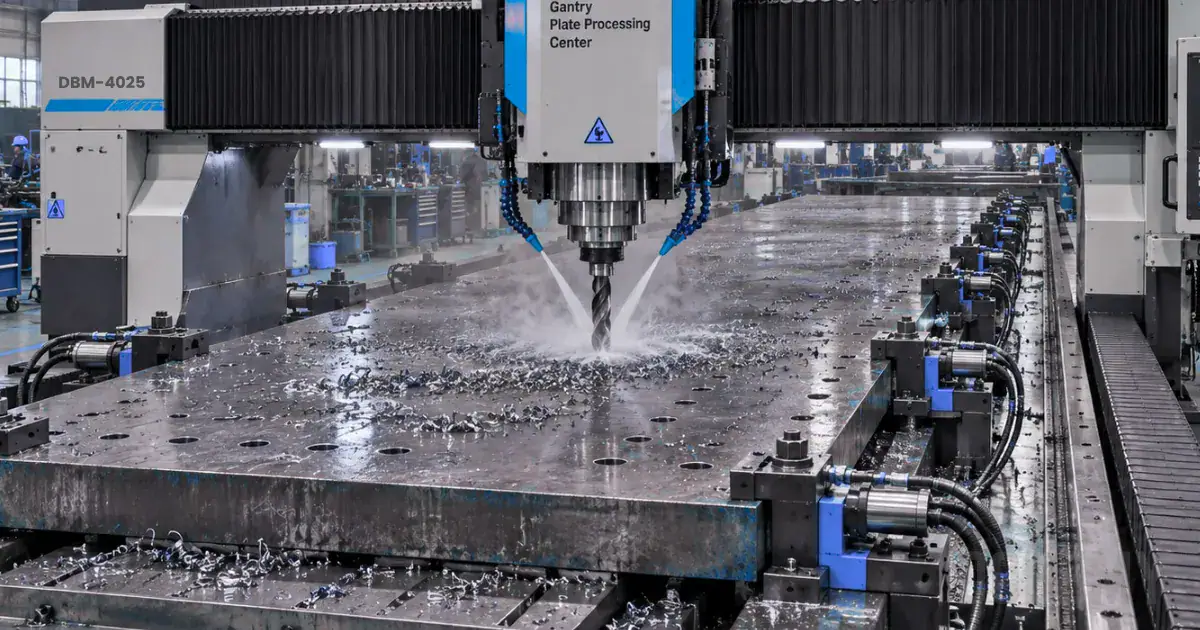
Dedicated plate processors move the spindle over a stationary plate on a bed with transfer balls or rollers. They handle large plates—often over 2 m wide and 12 m long—with hydraulic clamping. Drilling, tapping, marking, and countersinking happen in one pass. These machines suit high-volume structural and vessel plate work.
Vertical machining centers (VMCs) clamp plate to a T-slot table and offer tighter tolerances, milling capability, and tool changers with 20–40+ positions. Travel is limited by the table size, so large plates may need repositioning or multiple setups. A VMC is a strong choice when you need milling, pocketing, or tight-tolerance hole patterns on plates that fit the table.
Profile-processing machines drill beams, channels, and angles. They look similar in catalogs, but their workholding, axis layout, and clamping are built for structural sections, not flat plate. Do not assume a beam-line machine handles plate work well. The clamping geometry and bed support differ enough to cause problems with plate flatness and hole accuracy.
| Feature | Dedicated Plate Processor | VMC | Profile Machine |
|---|---|---|---|
| Typical plate size | Large (2+ m wide, 6–12+ m long) | Limited by table travel | Not designed for flat plate |
| Plate thickness range | 6–80+ mm (model-dependent) | Limited by Z travel and fixturing | Varies by section size |
| Tapping capability | Standard or optional, verify per model | Usually standard with rigid tapping | Often limited or absent |
| Milling / pocketing | Limited or optional | Full 3-axis milling | Limited |
| Tool changer capacity | Typically 6–12 tools | 20–40+ tools | Varies |
| Tolerance class | Suitable for structural work | Tighter, suitable for machined parts | Structural |
| Best fit | High-volume plate shops | Mixed machining, smaller plates | Beams, channels, angles |
Pick the format that matches your largest common plate and your tolerance requirements. A plate processor handles volume on big plates. A VMC handles tighter work on smaller plates. Mixing the two categories in a single purchase decision leads to compromises on both sides.
Steel CNC Drilling Tapping Machine Spindle and Torque Requirements
Steel demands more spindle torque and lower RPM than aluminum or mild sheet metal. Tapping is the harder operation: the tap engages the full thread profile, and the spindle must maintain synchronized rotation against the cutting resistance of the steel.
Two spindle specifications matter most:
- Torque at the working RPM, not peak torque. Tapping steel often runs below 500 RPM for larger thread sizes. A spindle rated at 22 kW may deliver strong torque at 3,000 RPM but far less at 200 RPM. Ask the supplier for the torque curve across the full speed range.
- Spindle power under continuous load. Drilling many holes in thick steel plate generates sustained heat and load. The continuous rating, not the peak rating, determines whether the spindle can hold up across a full shift.
Do not select a machine based on maximum drill diameter alone. The maximum drill size and maximum tap size may not apply to the same steel grade or plate thickness. A machine rated for a 40 mm drill in mild steel may only handle 30 mm in alloy steel at higher hardness. Confirm the limits for your specific material and hardness.
How to Read a Spindle Torque Curve
Suppliers sometimes publish only peak torque at peak RPM. That number tells you little about tapping performance. What you need is the torque value at the RPM your largest tap requires.
For example, if your largest thread is M20 in medium-carbon steel, the tapping speed may be well below 200 RPM. Ask the supplier: “What torque does this spindle deliver at 150 RPM?” If they cannot answer or the torque curve shows a steep drop at low speeds, the machine may stall or break taps on your largest threads.
Request the full torque-vs-RPM chart, not a single-point specification. Compare it against the torque your tap manufacturer recommends for the thread size, material, and depth you need.
Rigid Tapping and Thread Quality in Steel
Related guidance: DBM-430DT auto CNC drilling tapping machine.
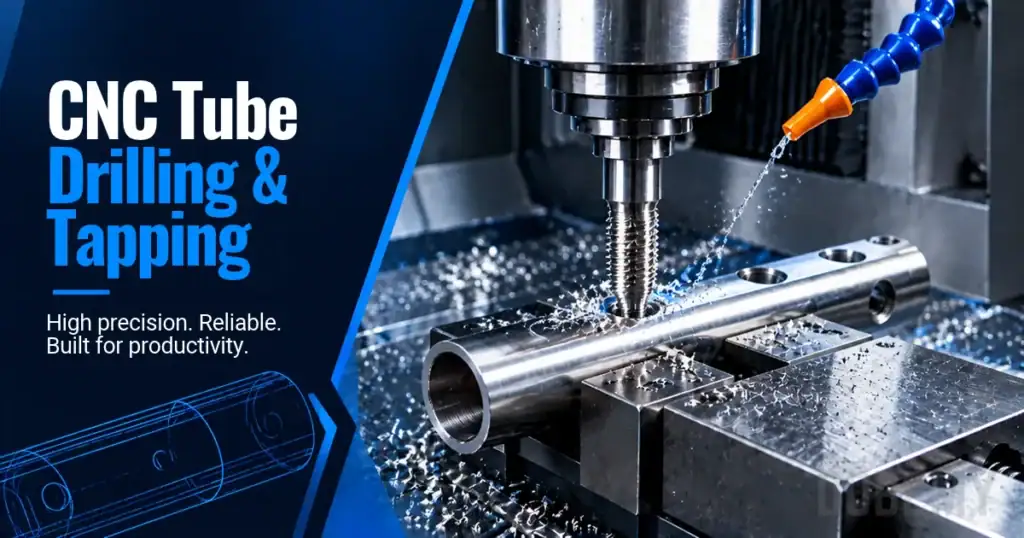
Rigid tapping synchronizes spindle rotation with axial feed at the exact thread pitch. The spindle reverses at the bottom of the hole to extract the tap. This method produces consistent threads and avoids the float and pitch errors that come with tension-compression tap holders on older machines.
Whether a machine supports rigid tapping depends on the CNC controller, the spindle encoder, and the servo system. Not all machines advertised for tapping include rigid tapping as standard. Confirm these points with the supplier:
- Does the controller support synchronized tapping (G84 rigid tap cycle or equivalent)?
- What is the maximum thread size the machine has demonstrated in the steel grade you use?
- Is the tapping function standard or an option that adds cost?
- What tap holder style does the machine use—rigid collet, synchronous, or floating?
For blind holes, the spindle must decelerate, stop, and reverse at a precise depth. This demands accurate encoder feedback and responsive servo control. Through holes are less demanding because the tap can pass through, but chip evacuation still matters.
Sandvik Coromant’s tapping operation guidance emphasizes secure clamping, correct drill size, and proper cutting fluid as the foundation for reliable tapping—before spindle speed even enters the picture.
Cutting Taps vs. Forming Taps
Cutting taps remove material to create the thread. Form taps displace material without cutting, producing no chips. Form taps work well in ductile materials like mild steel and aluminum, but they require higher torque and a larger tap-drill hole. In harder steels or steels with limited ductility, cutting taps are the standard choice.
The tap type affects your machine requirements. Form taps need more spindle torque but eliminate chip evacuation concerns. Cutting taps need less torque but demand effective chip clearing and appropriate coolant. Confirm the tap type with your tap supplier based on your steel grade, and then verify the machine can deliver the torque that tap type requires.
Workholding and Plate Support
Steel plate is heavy, but it can still shift during drilling and tapping if the clamps are too far from the hole. Lateral movement during tapping risks tap breakage and damaged threads.
Key workholding factors to evaluate:
- Clamp placement relative to the hole. Clamps should hold the plate close to the drilling and tapping zone, not only at the plate edges. Some plate processors use multiple hydraulic clamps that reposition automatically.
- Support beneath the plate. Thin plate (under 12 mm) can deflect downward during drilling breakthrough, causing burrs and inaccurate hole geometry. The machine bed or support system must prevent this deflection at the point of drilling.
- Datum and positioning. How does the machine establish the plate origin? Some systems use edge sensors or probes. Others rely on manual alignment. Probe-based systems reduce setup time on repeat jobs.
- Plate weight capacity. Confirm the maximum workpiece mass the table or bed supports, especially for thick plate over 40 mm.
SSAB and other steel producers note that rigid setup and adequate support beneath the plate are especially important when drilling and tapping thinner plates, where deflection and vibration increase.
What Happens When Workholding Fails
A plate that lifts or shifts during tapping can break the tap inside the hole. Extracting a broken tap from hardened steel is time-consuming and sometimes impossible without EDM. The cost of one broken tap—including downtime, extraction, and a potentially scrapped plate—often exceeds the cost of better fixturing. Evaluate workholding as a production cost factor, not an afterthought.
Chip Evacuation and Coolant for Steel Tapping
Related guidance: DBM-2030DT auto CNC drilling tapping machine.
Chips are the leading cause of tap breakage in steel. A chip that wraps around the tap or packs in the flute increases torque until the tap snaps.
Match the tap style to the hole type:
- Through holes: Use spiral-point (gun) taps that push chips forward through the hole.
- Blind holes: Use spiral-flute taps that pull chips upward out of the hole.
Coolant delivery affects both chip clearing and tap life. Through-spindle coolant (TSC) delivers fluid directly to the cutting zone and helps flush chips. External flood coolant works for shallow holes but may not reach the tap in deeper holes.
For tapping steel, many tap manufacturers recommend a non-water-soluble cutting fluid or an emulsion with extreme-pressure (EP) additives rather than plain water-soluble coolant. EP additives reduce friction and the built-up edge that shortens tap life in ferrous materials. Confirm the recommendation with your tap supplier for your specific steel grade.
Evaluate the machine’s chip management system as well: chip conveyors, coolant filtration, and tank capacity. High-volume plate drilling generates a large volume of steel chips that can clog a system designed for lighter work.
Coolant Delivery Checklist
- [ ] Through-spindle coolant available and compatible with your tooling
- [ ] Coolant pressure and flow rate sufficient for your deepest hole
- [ ] Filtration system rated for steel chip volume at your production rate
- [ ] Coolant type confirmed with tap manufacturer for your steel grade
- [ ] Chip conveyor or collection system sized for your daily chip volume
- [ ] Tank capacity large enough to avoid frequent refills during shifts
Automation, Tooling, and Additional Operations
Beyond drilling and tapping, consider what other operations you need in the same setup:
- Countersinking and chamfering before tapping improves thread entry and removes burrs.
- Layout marking (scribing or dot-peen) on the plate surface for downstream assembly.
- Milling for slots, pockets, or edge profiles—available on VMCs and some plate processors.
- Thermal cutting (plasma or oxy-fuel) is integrated on some gantry plate processors for combined cutting and drilling.
Automatic tool changers (ATCs) reduce cycle time when switching between drill, tap, countersink, and marking tools. Check the ATC capacity and tool-change time. A 6-tool carousel may be enough for simple drill-and-tap jobs. Complex parts with multiple hole sizes and thread sizes may need 12 or more positions.
Software and Programming Workflow
The machine’s CNC control and CAM software determine how quickly you go from a drawing to a running program. Evaluate whether the control accepts standard file formats from your existing CAD/CAM system. Some plate processors include proprietary nesting software that optimizes plate utilization and generates drilling and tapping sequences automatically. Others require you to program each hole manually or import from external CAM.
If you process many different plate layouts, nesting and job-tracking software can reduce programming time and material waste. Ask the supplier whether this software is included, optional, or third-party.
What to Verify Before You Buy
Related guidance: CNC tapping machine for electrical enclosures.
Catalog specifications tell you what a machine can do under ideal conditions. Your production conditions are different. Before placing an order, work through this verification list with the supplier:
- Test cut on your material. Send a sample plate or specify your steel grade and hardness. Ask the supplier to drill and tap your hole sizes and thread sizes and share the results—thread quality, cycle time, and hole-position accuracy.
- Cycle time for a representative part. Insist that the quoted cycle time includes plate loading, clamp engagement, tool changes, repositioning between holes, and unloading—not only cutting time.
- Simultaneous capacity limits. Ask whether the published maximum plate thickness, maximum drill diameter, and maximum tap size all apply at the same time, or whether some limits reduce when others are at maximum.
- Software and CAM workflow. How do you program the machine? Does it accept standard file formats from your existing CAD/CAM system? Is nesting software included for plate utilization?
- Installation requirements. What are the foundation, power, compressed-air, and coolant-system requirements? Does the machine need a pit for chip conveyors or a raised foundation for the bed?
- Service and spare parts. Where is the nearest service technician? What is the warranty scope? What spare parts should you stock for the spindle, tool changer, and hydraulic clamping system?
- Training and startup support. How many days of operator and programmer training are included? Is remote support available for troubleshooting after installation?
Treat every vendor specification as a manufacturer claim until you see it demonstrated on your material and your part geometry. A supplier willing to run your test part and share measured results is a stronger partner than one who only sends a catalog.
Send us your plate drawing, steel grade, hole sizes, thread sizes, and batch volume. We will review your requirements and recommend a machine configuration that fits your production needs.